TCNP Blog and News

Reduce Runoff

reduce_runoff

They say that April showers bring May flowers. But here in Alabama with our long hot summer days, those showers sometimes aren’t quite enough to keep our landscapes looking healthy and vibrant. Careful watering can keep your investment in turf, trees and landscape plantings healthy and beautiful. Watering early in the morning when it is coolest and least windy reduces the amount of water lost to evaporation. Make sure irrigation and sprinklers are not directed to impervious areas such as driveways and sidewalks, which will just waste water and cost you more money.

When it comes to reducing runoff, the same rules that apply to stormwater also apply to water from sprinkler systems and hoses: slow it down, spread it out, and allow it to soak into your yard. The more opportunity soil has to absorb the water and plants to uptake the moisture, the less opportunity water will have to leave your property and create polluted runoff.

The Allure of More

Let’s face it – we all want to have the latest smart phone, tablet, laptop, game system and flat screen TV. But our desire to be the first to own the latest greatest little gadget has resulted in a fast-growing surplus of electronic waste, or e-waste. The United States leads the world in producing e-waste, discarding about 6 billion pounds of it each year.

Besides taking up a lot of space in landfills, e-waste contains dangerous chemicals and heavy metals which can pollute water and land. In the United States, an estimated 70% of heavy metals in landfills come from discarded electronics. These heavy metals, which include lead, cadmium, mercury and arsenic, can leach from landfills into the water table and pollute groundwater. Groundwater feeds springs and streams, which in turn flow into rivers and lakes.

E-waste also contains as many as 60 elements, including valuable gold and platinum. These elements are not renewable, and recycling electronic devices provides opportunities for these materials to be recovered and reused, thereby conserving precious resources.

So what should you do with unwanted electronics? If the electronic device is still usable, donating it to a charitable organization is a good option. However, if the electronic device is broken or otherwise not usable, take it to a business or recycling center that will properly dispose of it. Calling Recycle Alabama at 252-7581 or visiting http://www.recycleAL.com is a great way to learn what to do with most things recyclable.

Mark Your Calendar!

May 9

Don’t doom your old electronics to a landfill! Bring them to the FREE Birmingham Electronics Recycling Day from 8 – 12 at LinnPark, Short 20th Street, in Birmingham. For more information, contact the Keep Birmingham Beautiful Commission at 787-5222.

May 11

Build your own rain barrel and start collecting rain water to use for yard irrigation. Call the Alabama Cooperative Extension System at 205.879.6964 Ext. 11 to register.

May 17, 18

Come on out and strut your pet’s stuff while supporting local animal charities at Do Dah Day in Rhodes and CaldwellParks, Birmingham. Visit http://www.dodahday.org to learn more.

jeffcoh2o_graphic_only

Lyn DiClemente
Jefferson County Department of Storm Water Management
B-210 Jefferson County Courthouse Annex
716 Richard Arrington Jr. Blvd. North
Birmingham, AL  35203
205.325.8741

diclementel@jccal.org

StoneShovel: A Bio Blitz Summary

1(DuPont Thompson’s Bridge)

First off let me say I am not a biologist, ecologist, scientist by training but these fields and what they investigate are of immense interest to me. Coming from a background in art I have spent the better part of my life observing and recording what I see & experience. There are not to many times this has not served me well. A couple weeks ago there was a bio blitz at Turkey Creek Nature Preserve. For those not familiar it is an intense look into the life forms and the environment of a particular area. This can be expanded on but the best way to understand how it works is to be involved with one and I will do my best to relate my experiences and thoughts on it.

To start dress appropriately, sturdy shoes, wet weather gear since it is a rain or shine event and salamanders enjoy that sort of thing. Layers are a good bet since its Alabama weather so you can bet it will change. Finally something to record what you see, pen and paper or in this case species lists and pencils.

IMG_6622BioBlitz participants discover TCNP’s rich ecological diversity

We met near the entrance gate to the preserve and the weather was wet and chilly so we made sure to get in the drainage swale and turn over rocks and piles of leaf litter. What? you say. why yes because thats precisely where we find Mr Slimy salamander. That and about half a dozen cranefly larvae. Let me start with Slimy or Plethodon mississippi Slimy Salamander                                                             Slimy Salamander (Plethodon mississippi)

as the name suggest this fellow can excrete a slime like substance, despite this it is a handsome black with white spots and can reach 4- 7 inches in length. Just try to get him steady on a measuring tape though. We would find many more his/her kin throughout the day.
IMG_6582

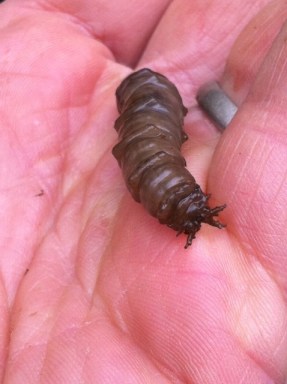
Crane Fly larvae (Tipulidae sp.)

The cranefly larvae was rather strange, imagine a small almond sized sack much like a bellows or accordion texture with a star shaped mouth that just wriggles around in the muck. To me it looks like it is food for other swifter predators ie Slimy! That’s another story. Interestingly there is an orchid by the name Cranefly orchid whose root looks somewhat similar to the larvae I just described.

That was how it started and as usual the further we wandered into the preserve the more we got ‘distracted’ by this or that. For me its plants. I was called ‘the plant guy’ and though I have no formal training to ID plants I enjoy trying to figure them out. The biodiversity of this 460 odd acres is impressive. If we think about the terrain for a
minute we have floodplain or riparian zone adjacent to the creek, which is right next to montane and rock outcrop habitats that blend into Longleaf pine and mixed hardwood forests. Blue Hole

Searching the rocks at Blue Hole

Each of these has its north and south facing slopes morning or afternoon sun exposures adding the fact it has been protected from development (thankfully) it can be a refugia of sorts for many types of plants. A great example of this is the Blue hole area where many folks swim and fish. Across the street we found Mountain Laurel, Prickly pear and Styrax americanus in full bloom!IMG_6583

American Snowbell Tree (Styrax americanus)

IMG_6617

Fire Pink (Silene virginica)

The Firepinks or Silene virginica were also in bloom. Blue clusters of Houstonia and hairyleaved Hieracium gronovii carpeted the mossy slopes beneath the beech and pine trees, which literally look like they are falling slowly down the hill. IMG_6618

Queendevil (Hieracium gronovii)

IMG_6593Pussytoes (Antennaria plantaginea)

Around the bend we follow our a trail up the slope past Paw Paw -Asimina triloba, Witch hazel Hammamelis virginiana and Heuchera americana or Alumroot. I am trying to look, hike and write all at the same time which, as impossible as it sounds, can be done but one ends up with a face full of branches if one is not swift enough. As we break into the sunlight atop the hill a sweet patch of sandstone greets us, great loaves of lichen covered rock turned sideways or on end depending on your perspective to catch the sandy gritty soils and natural debris. “Perfect timber rattler habitat.” Andy Gannon says with a grin. “Oh ok. Cool.” I say, but I am really focusing even more on the plants. Virginia pine hangs on the edges with many bluestem grasses, cat brier or
Smilax, beautyberry, and.. wait! Is that what i think it is!

IMG_6604Wild Pink (Silene caroliniana)

There is always one of those moments at a bio blitz, for me it was with a plant I first encountered several years ago in that same location. I could not identify it then and the picture I had was not detailed enough to get any of my plant geek friends interested.But this time I was in better company and had the benefit of taking some great courses at the Botanical gardens in Birmingham through Certificate in Native Plant Studies. I highly recommend these for the amateur or professional the subjects range from botany, taxonomy, propagation and many more. Anyway I digress. So, with more information and confidence and a better way to address my subject, I was able to inspect the plant closely and see that It had the same white flowers I remembered but was not a phlox as I had first guessed. The flower parts were external and with many phlox blooms the parts are inside the floral tube. Also the shape of the petals was not like a phlox. The leaves were fleshier and about 2 inches long and narrow with a slight widening at the tip, I remembered seeing the firepink near bluehole and thought this cannot be coincidental. Comparative analysis helped me narrow it down but my gut was telling me Silene but which one? We will have to find out later.

It is such an honor to be able to interact with the world in this way not as a taker but more as an observer. We do our best to put things back as wen find them while keeping some of the more interesting critters out for show and tell. A small scorpion
IMG_6629

Cave Scorpion  (Amblypygi sp.)

was plucked from its damp mossy cave as was a snake or two! The Midland water snake or Nerodia sipedon is an impressive specimen its musk is impressive as well..they can reach 50 inches or more and are mistaken for cottonmouth or copperheads. IMG_6650

Midland water snake (Nerodia sipedon)

Handling wild animals should be done by qualified persons or certifiable persons. But seriously, approach with caution and respect.

Once back at base camp, another biologist Scott Duncan, was able to verify that I had seen a silene as there were other populations found in the water shed. When I met with a native plant expert named Jan Midgley I found it was Silene caroliniana. It inhabits dry or well drained sites, rock outcrops, does not get very tall and ranges from white to pink in its flower habit.

IMG_6657Black Kingsnake (Lampropeltis getula nigra)

Oh wait there’s more under the pile of old roofing. A king snake who also is rather musky, was waiting for sunnier days, these snakes will eat poisonous snakes so if you like that idea let these guys live under your wood pile a while.

The interesting thing here is not everything we come across is clearly identifiable right away in my own notes I recorded over 150 plants ( many I had seen prior to this event and are a separate list) Each person will gravitate to different things and some have areas of expertise and so on so that will influence what is recorded. Its encouraging to know there are still some discoveries to make even when its just off the side of a road
near a place called Turkey Creek. I will be back to explore some more later this year and I was glad to participate in the event.

IMG_6596

Mystery Moth (unknown)

Arnold Rutkis is Stoneshovel designing naturalistic, edible, earth and stone landscapes.His website is http://www.stoneshovel.com or his blog at stoneshovel.wordpress.com you can see some of his work near the falls at Turkey Creek Preserve in the Eco scape there.

Exploring Pinson’s Legacy: Native-American Settlements

Long before the arrival of European settlers, Native-American tribes, most notably Creek (or Muskogee),  roamed through the Pinson area and depended on the abundant supply of water and the bounty that came from it – plentiful game, wild fruits and vegetables, fertile land to grow crops, and trees for shelter. Rocks and minerals could be used for tools and weapons.

Even before Muskogee tribes came into the area, Pinson was home to native peoples categorized as living during the Late-Woodland period. The Woodland period dates between 1000 BCE to 1000 CE. In Alabama, the Woodland period was characterized by increasing cultural complexity and population growth,  the adoption of agriculture, emergence of pottery-making, use of the bow and arrow, and complex ceremonies surrounding death and burial, including construction of burial mounds and burials in caves. Population growth prompted development  of wide-spread settlements, often settling on small streams. Use of the bow and arrow spread from cultures in the west, making hunting less of a group activity than it had previously been. Families became more self-sufficient and raising crops began to replace hunting as the most important food-producing activity. Pottery developed for a variety of uses, for example, storage of crops, such as maize and squash. Over time, mortuary practices simplified, possibly a decline in ceremonialism signaling a religious evolution focusing on reverence for ancestors of certain lineages. (Later Muskogee lineages were matriarchical in nature.) Evidence indicates that many small groups occasionally gathered together to build mounds and maintain long-range ties. Pottery from different villages was likely bartered and, and over time, developed similarities in form and decoration. Major villages where mounds were located expanded their functions from burial places to centralized places for civic and ceremonial functions. The combined developments of surplus food, special lineages, and, mound centers marked changes in society much different from how people had lived up to that point; changes that set the stage for developments that would take place in subsequent Mississippian periods (highlighted in Alabama by sites such as Moundville and Bottle Creek.)  Cultures in the Tennessee River Valley may have also begun to develop Mississippian characteristics about this time. (It is an interesting coincidence that the Pinson Mounds archaeological site in western Tennessee is also a Late-Woodland site that was used for ceremonies and burials.)

Pinson has one of the few known Woodland-period caves in Alabama. Located off of Dewey Heights Road, the cave was first excavated extensively by Dr. Paul H. Nesbitt and Carey B. Oakley from the University of Alabama in 1969 and 1970. The Pinson Cave was used as an ossuary (a place or receptacle for the bones of the dead) dating to circa 900 CE.

Pinson Cave

References to the cave dating to the Hamilton period likely refer to the type of projective points found, called Hamilton points, named from the first examples found in Hamilton County, Tennessee, near Chattanooga. Hamilton points are small early triangular arrow points that have straight, slightly concave sides, often serrated,  and a straight to slightly concave basal edge. Hamilton points are often very thin and exhibit high quality craftsmanship and flaking skills and technique.

Hamilton Projectile Point

There were two paths into the cave: a vertical shaft as well as a more accessible walkway, which was flanked by stones to make a primitive entry. Oakley’s excavation of about half of the cave yielding the remains of more than fifty individuals. Most interments appear to have been made in the flesh, although one cremated burial bundle was documented. Most burials were dropped into the cave via the vertical shaft. Other artifacts include marine-shell ornaments, bone pins, sandstone saws, various projectile points and a small number of pottery sherds.

Please NOTE that the Pinson cave site is located on private property and is OFF- LIMITS to the public.

This article is intended to provide accurate historical information to a general audience. Material contained herein is gathered from reputable online and traditional sources, but unless otherwise noted, is not the result of original scholarship or research by the author.

–E. E. (Skip) Campbell, Ph.D.

Skip Campbell retired from UPS in early 2012 after 38 years as a senior manager, working in numerous locations in the United States and abroad, with primary responsibilities in operations and industrial engineering. He received his BS degree in Applied Science and Operations Analysis from the University of Alabama and holds Master’s degrees in Engineering Management, Quality and Management,. Skip holds a Ph.D. in Organizational Behavior and Development, with concentrations in Organizational Theory and Macroergonomics. Skip is a Senior Member of the Institute of Industrial Engineers and sits on the Board of Visitors for the College of Continuing Studies at the University of Alabama. Since retiring, Skip serves as an Adjunct Professor with the College of Continuing Studies (Osher Lifelong Learning Institute) at the University of Alabama and focuses his academic research efforts on the area of pre-20th century Alabama history. Skip belongs to a number of historical and cemetery preservation associations. He and his wife Denise have 3 grown children and 2 grandchildren.

JeffCo H2O: Spread The Word

jeffcoh2o_graphic_only
When Less is More
     There are a few things that having more of can be a good thing.  Money and time are probably two of those things.  But with pesticides, herbicides and fertilizers, using more than is recommended doesn’t provide any benefit, and in some cases can do more harm than good. Soil can absorb only so much of these products, and overuse just wastes your time and money. The package directions will indicate the amount of product to use based upon the size of the area to be treated, and will recommend the application rate to set on the spreader or sprayer dial so that the product will be properly applied.  When to use yard chemicals is important, too.  Many people think that it is best to apply granular fertilizer right before or during a rain.  Actually, that is the worst time, because rain will wash much of it from your yard before the soil has time to absorb the nutrients, and will create stormwater pollution.  Choose a dry day to apply fertilizer, and then carefully water it in with a hose or sprinkler. 
     How big is your yard or garden? You know the formula: length X width = area. Don’t forget to subtract paved areas such as sidewalks and driveways from the total.
 
What Goes Around Comes Around
     We’ve all heard that phrase at one time or another.  And when you consider chemicals used in lawn and garden care, it couldn’t be truer.  Fertilizers, herbicides and pesticides can be very helpful in achieving your landscape goals if you use only what your yard needs and carefully apply these products.  However, feeding your lawn and garden or ridding them of unwanted pests has the potential to create unintended results.  
     Many pesticides and herbicides cannot distinguish between a ‘pest’ and a ‘pal’, and most contain broad spectrum chemicals that kill all plants and insects they contact.  That includes insect ‘pals’ like bees and butterflies which are important in plant pollination.  Pesticides and herbicides also can be harmful to pets and humans if they are inhaled, absorbed through the skin, or eaten.  Washed from your yard by rain or carried by wind into nearby streams, these chemicals do the same thing in water that they do on land:  herbicides and pesticides kill fish, animals, and plants that live in and around the water while fertilizers cause algal blooms that deplete oxygen in waterways, killing aquatic life.  Pesticides and herbicides also can enter the food chain when animals and plants absorb and retain these chemicals in their systems.  These affected plants and animals could be consumed by other animals and even humans.  That’s why it’s so important to choose the least toxic chemicals for the job and control where, when and how they are applied. 
     One alternative is to let nature do some of the work by establishing an eco balance in your yard.  Insect ‘pals’ like ladybugs, preying mantis, green lacewings and nematodes (worms) naturally feed on pests such as beetles, aphids, ants and mosquitoes.  Native plant ‘pals’ also can help create this equilibrium in your yard since many act as hosts for insect ‘pals’ and are resilient enough to thrive in our local conditions.  Over time, your efforts can become a sustainable solution to keeping your lawn and garden free from the effects of pests and reducing the need for yard chemicals.   
Mark Your Calendar!
April 13
Just in time for spring cleaning, Recycle Alabama Day from 9 – 2 at the Downtown Recycling Center, 2431 2nd Avenue North.  Visit http://www.recycleAL.com for details.
April 27
Come on out to the Birmingham Botanical Gardens 11-4 and celebrate the environment at Earth Day at the Gardens.
April 30
Learn how Integrated Pest Management can help you safely control your garden pests at the Urban Gardening IPM Workshop.  Call the Alabama Cooperative Extension System at 205.879.6964 Ext. 11 to register.
spreadword_spread
 
Lyn DiClemente
Jefferson County Department of Storm Water Management
B-210 Jefferson County Courthouse Annex
716 Richard Arrington Jr. Blvd. North
Birmingham, AL  35203
205.325.8741

diclementel@jccal.org

TCNP Currents: The Hanby Enterprise Part 2

This month, we will conclude The Hanby Enterprise story at Turkey Creek. Part 1 of this can be found HERE.

David Hanby was around the age of 18 when he moved to Alabama with his father. He was around 26 when he helped his father, John Hanby, construct the Hanby Mill and forge on Turkey Creek. Richard Anderson suspects that in addition to John’s age, the extreme labor demands required in blacksmithing meant that, David was likely to have taken over most of these duties by the late 1820s.

Realizing the potential wealth of central Alabama’s natural resources, David’s efforts to expand the enterprises he helped his father create did not end at blacksmithing and milling. According to Dr. Allen J. Tower, in his article entitled “The Changing Economy of Birmingham and Jefferson County” Published in the Journal of Birmingham Historical Society (January 1960), around 1840 David began mining and selling coal.  This operation was not quite as straight forward as it might sound, however, because the most lucrative market for coal at the time was in Mobile, Alabama.  To reach Mobile, David, yet again, utilized Alabama’s rich resources: its interconnected water ways (since there were no railroads in the area until the 1880s). Using 25 foot long “flatboats” packed with coal, David traveled from the Mulberry Fork to the Black Warrior River and all the way down to Mobile Bay. After arriving in Mobile and selling his cargo, he would disassemble the flatboats and sell the lumber.  This must have proved to be a particularly lucrative venture, since Dr. Tower notes that by 1844 David braved this journey up to ten times a year.

flatboat

Above: An example of a typical flatboat used during Hanby’s time

Time and age grind away, and what was once new and lucrative will eventually find itself worn and brittle. Despite the prosperity and scope of the Hanby enterprise, it too, was subject to the terms of age. In 1865, David’s life came to an end when a brigade in Union General Croxton’s forces killed David, and destroyed his operations at Turkey Creek.  While it remains unclear why the Hanbys were targeted for this assault, we do know that Croxton’s mission was to destroy Confederate supply lines and manufacturing sources. It can be assumed that the Hanby operation was providing the Confederate army with munitions or other goods.  Further expounding this mystery is the circumstance surrounding David’s demise. One local legend suggests that while on a hog hunt, David in his advanced years, decided to take a nap under a tree.  While napping, Union troops advanced on David’s position, startling him out of his sleep. When asked to lower his hunting rifle by Union troops, David who was partially deaf, only starred back in surprise at the soldiers. Feeling left without any other recourse, the soldiers tragically fired on David.  After David’s death, his wife sold his property along Turkey Creek to William Nabers, effectively ending all operations at Turkey Creek.

Today, after years of natural and human disturbances, very little remains at Turkey Creek to suggest the scope of the operations that once existed there.  What does remain is a wealth of history and stories told by a community that shares a passionate respect for their forefathers and the painstaking efforts they took to settle this area. So, on your next visit to the Turkey Creek Nature Preserve, keep these stories in mind, but please, respect the preservation of this history by leaving it as you found it for future generations.

For more information related to the history of the Preserve, come out for one of our Living History Programs. Event dates can be found on our events calendar.

Next week, contributing author Lyn DiClementel, will explore the importance of finding the right balance when comes to applying chemicals to their lawn or garden in the JeffCo H2O column.

Until then, we’ll see ya downstream!

Charles Yeager

Manager, Turkey Creek Nature Preserve

cropped-dsc_0141.jpg

Historical details and images are an interpretation of Richard K. Anderson, Jr findings published in “Turkey Creek Cultural Resource Mapping Project for Proposed Turkey Creek Preserve Pinson, Alabama” 2002

Turkey Creek Longrifles: Andrew Jackson Part I

Since the Turkey Creek Longrifles do a Creek War Tennessee Militia impression, I thought it would be appropriate to discuss General Andrew Jackson.

170MiscAndrewJackson

Once, America had heroes and one of these was Andrew Jackson. The life of Jackson is one of the most remarkable, if not astonishing, stories in the history of the United States. Born in South Carolina in 1767 to immigrant Scots-Irish parents, Jackson had humble beginnings. Jackson’s father died before he was born leaving him, his mother and two brothers. Jackson received a spotty education from his uncles during his childhood.

In 1779 during the American Revolution, Jackson became a courier with the Patriot militia, earning his first military rank at the age of 12. His older brother, Hugh, was killed at the Battle of Stono Ferry. Shortly thereafter, he and his brother Robert were captured by the British, beginning the first legend of Jackson.

Following their muddy footprints on a rainy day, a British patrol had tracked to the two messenger boys to a farmhouse and seized them. When the British officer ordered Andrew to clean the mud from his boots, he protested and defied the order stating he was a Prisoner of War and would not belittle himself by cleaning the officer’s boots. The officer drew his sword and Young Jackson blocked the blow, scarring his hand and forehead, a scar he would carry for the rest of his life.

These physical scars were nothing compared to the emotional ones to come. While in British captivity, both Robert and Andrew contracted Smallpox. Andrew’s mother was allowed to care for the boys and other American prisoners. Robert soon died of Smallpox, followed by his mother Elizabeth Jackson, from Cholera contracted from her tender care of the prisoners.

At 14, Jackson was an orphan with a fierce hatred for the British, who he blamed for the loss of his entire family.

Through the help of his uncles, Jackson, a self taught lawyer, eventually became a circuit judge. He was a protégé of William Blount, the second Governor of The State of Tennessee.  Jackson was elected as the first Representative to Congress when Tennessee gained statehood.

It was during this time that he met and married the love of his life Rachel Donelson Robards. Rachel was in an unhappy, possibly abusive marriage to a Kentuckian named Lewis Robards.  Some say Rachel fled for her life, others say Robards put Rachel on a flatboat boat to Spanish Natchez and boasted publicly he was rid of his wife, divorce by abandonment. Others say Rachel fled to Nashville and she and Jackson, acting as her protector, went to Spanish Natchez where they were married in 1788.  Returning to Nashville, Jackson learned that the Robards divorce was not legal and that Robards had petitioned that Rachel and Andrew were adulterers. The official Kentucky divorce was grated, not due to abuse and abandonment by Robards, but by bigamy and adultery by Rachel, who was shamed by the scandal for the rest of her life. Jackson and Rachel married again in Nashville. Jackson defended his wife’s honor, carrying a pistol ball in his chest from a duel over this matter.

During this time, the state of Tennessee was involved in an on-again/off-again war with the Cherokees who supported Britain in the Revolution.  These Chickamauga Cherokee Wars and smaller skirmishes were to continue until around 1800. Sometimes the Cherokee operated together as allies against the Tennesseans with their traditional enemies to the south, the Creeks.

In 1801 Andrew Jackson received his second military rank, he was elected Commanding General of the Tennessee Militia. This was pretty remarkable considering Jackson’s previous military experience was only as a messenger boy.  Even more astonishing, the title was conferred to Jackson over Col. John Sevier, Tennessee’s first Governor, Governor of the Free State of Franklin, Hero of Kings Mountain and Tennessee’s commander in the field from the American Revolution and all through the Cherokee Wars.

This lowly uneducated orphan would eventually prove himself to be one of the greatest American military commanders of his time, if not all time.  His test would come in the War of 1812.

Look for the conclusion of this story in April.

The Turkey Creek Longrifles open their 1814 camp to the public once a month at Turkey Creek Nature Preserve. For more information please visit our events calendar.

longrifles

Exploring Pinson’s Legacy: A Rich And Varied History

As a kid growing up in Tarrant and Inglenook during the 60’s and 70’s, I had, of course, heard about Pinson and the surrounding area. In the summer, we would drive the 11 or so miles up old Highway 79 so that we could go swimming at Tapawingo. When I was in the Boy Scouts, we spent days and weeks camping at Indian Valley. Most of us had heard about the old Green cemetery next to Kent Corporation, even if we didn’t necessarily know about who was buried there or what their significance was. In the winter, Pinson always seemed to be about 5 degrees colder than Inglenook. We would go to Camp Cosby out on Old Springville Road, or we would sometimes make our way to Turkey Creek to swim in the Blue Hole or body-surf down the falls. In other words, we were living out our daily lives; thinking about all of the things that kids normally think about, but sure didn’t usually include thinking a lot about Pinson’s history.

And, unfortunately, it is often the same today…In our busy world of smart phones, Facebook, and the 24-hour news cycle, it’s all we can do to deal with our normal daily responsibilities with its litany of IM’s, soccer practices, and dentist appointments. With all of the demands on our time and energy, it’s easy to take Pinson’s history for granted.

In an attempt to raise awareness of a history that we should both know and protect, I will be writing a series of articles exploring some common questions about the rich and varied history of Pinson and the surrounding area.

For example, you may ask “was Pinson always Pinson?” If so, then you will want to be on the lookout for future articles in this series, when we talk about the area’s past, including some of its earliest pioneers and what names the settlement came to be known by. You may not know that the town of Pinson is almost 200 years old and is one of the oldest settled areas in Alabama (in fact, the settlement was here before Alabama became a state); that the Pinson area was once home to ancient Native-Americans, including one of the oldest- known (ca. 900 CE) Native American cave dwellings and burial sites in the United States or that Pinson was the home of a former slave that became an important African-American inventor. You may be surprised that there is an assassinated United States Congressman buried in Green Cemetery. There are also at least two Revolutionary War soldiers buried in the area. You may not realize that Pinson has important connections to the War of 1812 and the Civil War. In addition, Pinson’s roots link us to our neighbors in surrounding cities and counties and read like a who’s who of early pioneers and well-known families, including Davy Crockett, no less.

Since these articles are about our history as a community, suggestions on particular questions or historical areas that you would want to know more about are encouraged…

Pinson 1911Downtown Pinson,AL 1911

–E. E. (Skip) Campbell, Ph.D.

Skip Campbell retired from UPS in early 2012 after 38 years as a senior manager, working in numerous locations in the United States and abroad, with primary responsibilities in operations and industrial engineering. He received his BS degree in Applied Science and Operations Analysis from the University of Alabama and holds Master’s degrees in Engineering Management, Quality and Management,. Skip holds a Ph.D. in Organizational Behavior and Development, with concentrations in Organizational Theory and Macroergonomics. Skip is a Senior Member of the Institute of Industrial Engineers and sits on the Board of Visitors for the College of Continuing Studies at the University of Alabama. Since retiring, Skip serves as an Adjunct Professor with the College of Continuing Studies (Osher Lifelong Learning Institute) at the University of Alabama and focuses his academic research efforts on the area of pre-20th century Alabama history. Skip belongs to a number of historical and cemetery preservation associations. He and his wife Denise have 3 grown children and 2 grandchildren.

JeffCo H2O: What’s the Roof Got To Do with It?

jeffcoh2o_graphic_only

What’s the Roof Got to Do with

It?

Actually, a lot!  During a one inch rain, a 1,000 square foot roof has about 600 gallons of stormwater running off of it.  That’s 600 gallons that are moving very quickly, picking up whatever is on the ground in your yard, carrying it into the storm drainage system, and emptying into the nearest waterway.  There are many ways to reduce the amount of stormwater that leaves your yard.  Collecting roof runoff in a rain barrel and using it later for yard irrigation, or diverting downspouts to a rain garden or natural area to allow water to soak into the ground are just a few.  How much stormwater runs off your roof? Just multiply the roof square footage X 0.6 (gallons per square foot per inch of rain).

The Middle

When it comes to stormwater pollution, the middle is where it all happens.   From your roof to the nearest waterway, anything on the ground or exposed to rain can become a pollutant!  And most of these sources of stormwater pollution come from our everyday practices:  fertilizers, pesticides and herbicides from yards and gardens, motor oil and grease from miles of roads and parking lots, heavy metals from roofs, eroded soil from construction sites and home landscaping projects, waste from pets, and litter and trash are carried by stormwater into the storm drainage system where it all flows untreated into waterways.

If you consider that 659,000 people live in Jefferson County, the amount of stormwater pollution that we generate each day is….. well, it’s a lot.  And since we get about 54 inches of rain each year, managing stormwater in your yard is a good place to start.  Anything that slows it down, spreads it out, and allows it to soak into the ground will make a positive difference in our water quality.

Creating natural areas and planting trees in your yard are excellent ways to prevent stormwater from leaving your property.  Depending upon their size, trees can absorb hundreds of gallons of stormwater every year.  In addition, the leaf canopy slows rain drops while the root system helps anchor the soil, reducing erosion.  When selecting and planting a tree, make sure that the site you choose will accommodate its full grown size as well as its water and sunlight requirements.

Reducing the need for irrigation and chemicals is another way to make your yard more stormwater friendly.  Consider using pavers to transform some existing high-maintenance turf areas into permeable patios or paths.  Pavers that are set into sand or gravel are a decorative and easy addition to your yard, and allow stormwater to soak into the ground.  Your new path or patio also will reduce yard maintenance since it won’t require mowing!

Mark Your Calendar!

March 27

Four Legged Gardening.  Grab a lunch and head to the Birmingham Botanical Gardens for a free Lunch & Learn Seminar from 11:30 – 12:30.  Discover how to create a safe environment for your pets by learning the difference between pet friendly and unfriendly plants.

roof2stream

Lyn DiClemente
Jefferson County Department of Storm Water Management
B-210 Jefferson County Courthouse Annex
716 Richard Arrington Jr. Blvd. North
Birmingham, AL  35203
205.325.8741

TCNP Currents: The Hanby Enterprise Part 1

photosFor most, it is a small piece of local paradise, a chance to beat the heat, catch a fish, take a hike, or snap a photograph. Any local knows you always arrive early (parking can be tricky) and do not forget your socks (the rocks are slick!). Whatever your reason for visiting, Turkey Creek Nature Preserve is a place of unique beauty that attracts thousands of visitors every year. Many visitors, however, are unaware that in addition to its rich natural resources, the Preserve plays a pivotal role in Alabama’s early industrial development. In fact, the most popular destination at Turkey Creek Nature Preserve, known simply as The Falls, was once the center of one of the biggest industrialist operations in Alabama, and the home of John T. Hanby.

Around 1774, John Hanby, was born into the machinist’s trade, in Henry County, Virginia. It is believed that Hanby operated a small forge in Virginia, where he crafted a variety of tools, locks, and bored rifles. Around 1800, Mr. Hanby sold his land in Virginia and eventually made his way down to Lincoln County, Tennessee. During the War of 1812, John Hanby received a Captain’s commission in the 49th Regiment of Lincoln County. Under General Coffee, Hanby traveled down through Alabama working as a machinist and blacksmith. Many believe that Coffee’s regiment camped near Turkey Creek, as they journeyed south. If they did, Mr. Hanby’s keen observation skill and business savvy may have alerted him to the rich opportunity for development along the banks of Turkey Creek. Another theory suggests that Hanby may have relied on tips from prospectors to the region. Whatever the cause, after his military service ended around 1819, Hanby and his family settled at Turkey Creek.

While Hanby’s enterprises were spread across present day northern Jefferson County and Blount County, his operational center was located in Pinson. His operation at the Falls was believed to include not only his home, but also, a Dam, grist mill, forge, and a niter works.

history map2

Mill Dam: Mr. Hanby choose his site carefully, with the knowledge that his work would require not only rich mineral resources, but also the means to power his bellows and grist mill.  Observant visitors to Turkey Creek Nature Preserve may have noticed a clue to how he produced this power, as well one of the first structures Hanby developed. Approximately 100 feet upstream of the “Big Rock”, a straight line of 19 small holes is bored into the rock. These holes once held iron pins, which provided support for a 6-foot tall wooden dam that tamed the waters of Turkey Creek.

wooden Dam_2 Wooden Dam

Grist Mill: From the dam, Hanby harnessed the power of Turkey Creek waters down a wooden flume to a large waterwheel. Investigations of the area suggest that this wheel, as well as Hanby’s Mill, were located on or behind the “Big Rock.”  Hanby’s mill wall can still be seen today opposite the “Big Rock.” This mill is likely to have grinded wheat into corn and flour for people as far away as Tuscaloosa and Selma in addition to have providing power for another source of revenue for the Hanby family, his forge.

Forge: From the Mill, belts were used to drive a bellows, producing fire hot enough to smelt iron. While this area is still under careful archaeological examination, artifacts including slag, hand forged nails, and brown ore confirm its relative location on the flat, glade next to the current road. The Hanby family is likely to have smelted brown ore for simple tools, kitchenware, horseshoes, and even possibly guns.

Hanby Homesite: An unnaturally flat spot of land on the hill above the Falls, is suspected to be the site of Hanby’s home. This flat area measures approximately 96 feet long, and would provide enough space for a small living quarters for himself and his family.  Nearby, a cold water spring head lined with stones is evidence of a possible cold food storage building. Many people today believe that Hanby’s home was relocated around 1910 by William Nabers to a site across from the Blue Hole. Mr. Nabers home was destroyed in a fire in the 1960s, so very little evidence remains.

Sometime in the 1820s, John Hanby’s son, David Hanby, began to take over the Hanby enterprises. The story of David Hanby starts with turbulent raft rides and ends in flames. Check back next month to learn how this story ends!

For more information related to the history of the Preserve, come out for one of our Living History Programs. Event dates can be found on our events calendar.

Next week, contributing author Lyn DiClementel, will provide readers with some insight into the importance of controlling stormwater runoff in her column “JeffCo H2O.”

Until then, we’ll see ya downstream!

Charles Yeager

Manager, Turkey Creek Nature Preserve

cropped-dsc_0142.jpg

Historical details and images are an interpretation of Richard K. Anderson, Jr findings published in “Turkey Creek Cultural Resource Mapping Project for Proposed Turkey Creek Preserve Pinson, Alabama” 2002

Turkey Creek Nature Preserve Currents

cropped-dsc_01411.jpg

Welcome to the newly developed Turkey Creek Nature Preserve blog and website! Through this site, our goal is to provide the public with a steady stream (pun intended) of information in topics relevant to the life of TCNP, ranging from history and the environment, to events and support opportunities. We have a fantastic group of contributing authors volunteering their time to help make this blog possible. Weekly updates are scheduled, with occasional bonus posts of supplemental materials. If you have any suggestions, or would like to contribute your own articles, please contact Charles Yeager at cyeager@bsc.edu.

Until then, we’ll see ya downstream!

Charles Yeager

Manager, Turkey Creek Nature Preserve

TCNP

TCNP announcing new Pedestrian Friendly Hours

Looking for a quiet place for a scenic morning walk, but do not wish to deal with the threat of traffic?

This Friday and Saturday (January 25th and 26th), Turkey Creek Nature Preserve will begin providing pedestrian friendly hours from 7am-9am. During this period, the main gates will remain closed to motor vehicular traffic, but a side gate at the main entrance will be opened to allow pedestrian traffic into the Preserve.

At 9am the main gates will be opened, to allow normal traffic flow.

Expect these changes to remain in effect for now on. Meaning, that motor vehicles will not be allowed within the Preserve until 9am on Friday and Saturdays.

Pedestrian only hours

Pinson Recycling Trailer

530325_10150945940686155_1005889778_n

Thank you Pinson, for making the Recycling Trailer such a huge success! Since May of this year, volunteer workers have taken a full trailer to be recycled every week.  This unexpected outpouring of support has been wonderful. However, there has been some confusion about what items and materials are accepted. On each receptacle, guidelines for acceptable materials have been posted. Please, take a moment and review those so that we can successfully recycle the items brought to the trailer. When unsorted or unacceptable items are deposited, they will not be recycled and they make the task of delivery more difficult.  Here are some quick guidelines to go by:

Accepted Paper: Cardboard and Office paper ONLY (no food contaminated items or wet paper)\

Accepted Plastic: Plastic bottles and Jugs

Aluminum Cans only; no steel cans (can food or dog food cans)

DO NOT BRING: Plastic Bags, Aluminum Foil/pans, or Styrofoam

We realize that the trailer fills up quickly, but please, do not leave items outside of the trailer. Also, as a space saving effort, please, crush boxes, cans, and plastic containers.

Every week, volunteers happily take time out of their week to deliver your recycling items. Please support their efforts by using the trailer responsibly and properly. Your support will go a long way towards making the difficult task of delivering your materials much easier.  If you have any questions about accepted materials, or would like to help with this effort, please, send an email to cyeager@bsc.edu